
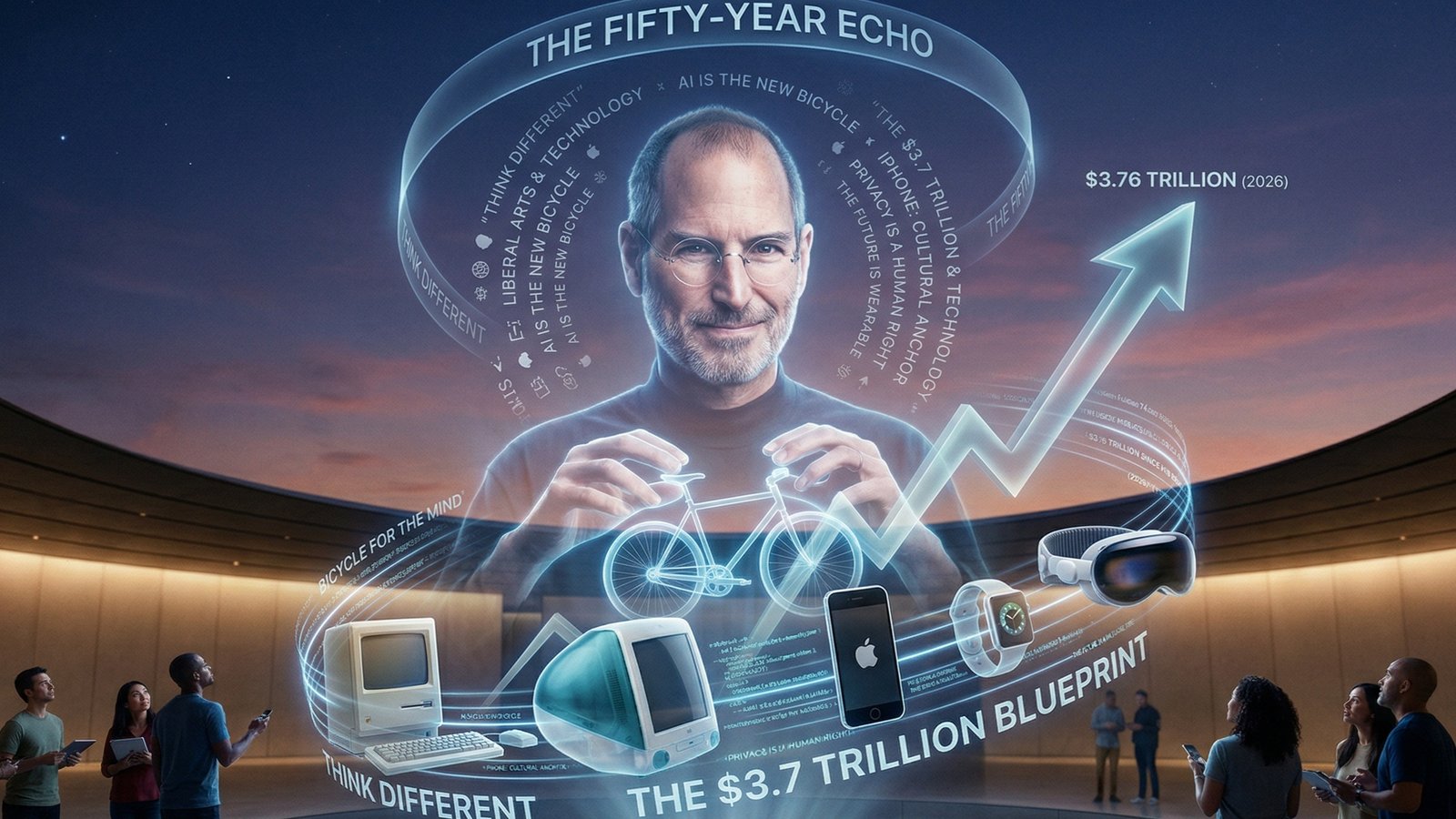
Apple celebrated its fiftieth anniversary this April. The milestone feels like a victory for a specific ghost. Steve Jobs passed away nearly fifteen years ago. Yet, his influence remains stronger than ever in 2026. Today, we look at why his legacy is truly irreplaceable.

The company started in a dusty Los Altos garage. Now, it stands as a global titan worth trillions. Investors often wonder if the magic has finally faded. Nevertheless, the recent product launches suggest otherwise. The core DNA of the founder still dictates every pixel.
Currently, the tech world feels cluttered and chaotic. Most companies chase every shiny new trend. Apple behaves differently under the weight of history. Consequently, they often wait until they can achieve perfection. This patience defines the legacy Jobs left behind.
The $3.7 Trillion Blueprint
As of April 2026, Apple commands a massive valuation. The firm sits at roughly $3.76 trillion. Financial experts attribute this success to consistent ecosystem growth. Furthermore, the hardware and software integration remains unmatched. Steve Jobs originally fought for this closed-loop system.
Critics once called this approach a “walled garden.” However, users clearly appreciate the seamless safety it provides. The stock price reflects deep trust in the brand. Therefore, the financial health of Apple is a direct result. It stems from choices made decades ago.
Meanwhile, the competition struggles to replicate this deep synergy. They often focus on raw specs instead of feelings. Jobs insisted that technology must serve the human spirit. Ultimately, this philosophy generates more profit than any spreadsheet. It transforms customers into loyal lifelong fans.
The Ghost of Steve Jobs in the Vision Pro
Spatial computing arrived with a bang two years ago. The Vision Pro represents the ultimate Jobsian product. It focuses on the intersection of liberal arts and technology. Specifically, the headset prioritizes the user’s emotional experience. This focus is a hallmark of the late founder.
Designing such a complex device requires immense courage. Apple engineers worked in secret for over a decade. Accordingly, the final product feels polished and intentional. It avoids the clunky aesthetics of earlier VR headsets. Indeed, it looks like high-end furniture for the face.
Interestingly, Jobs always wanted to replace the television. He spoke about an integrated media experience. The Vision Pro finally delivers on that specific dream. Thus, the device feels like a posthumous gift. It proves that the old roadmap still guides the way.
“It’s A Bicycle for the Mind!” – Steve Jobs
In 1990, Jobs called the computer a bicycle. He meant it amplifies our natural human abilities. Today, artificial intelligence has taken that role. However, Apple treats AI with a unique sense of caution. They call it “Apple Intelligence” to keep it human-centric.
Moreover, the focus remains on privacy and local processing. This decision honors the founder’s obsession with user control. Users do not want a robot that stalks them. Instead, they want a tool that helps them create. Consequently, the new AI agents feel like helpful assistants.
Notably, the company avoids the term “AI” in marketing. They prefer to discuss what the user can achieve. This subtle shift reflects the “Think Different” era. It emphasizes the person over the machine. Therefore, the bicycle for the mind is now a jetpack.
Steve Jobs: The Prophecy of 1983
Few people remember a specific speech from 1983. During that talk, Jobs predicted conversational AI agents. He described a machine that captures a person’s principles. Then, you could ask the machine questions later. Remarkably, this vision is becoming a reality in 2026.
Modern large language models act like these digital twins. They can simulate the wisdom of past leaders. Furthermore, the Steve Jobs Archive utilizes these tools responsibly. They want to inspire new generations of creative thinkers. Effectively, Jobs saw the future forty years before us.
Meanwhile, his peers focused mostly on simple data processing. They did not see the computer as a companion. Jobs recognized the potential for a spiritual connection. Accordingly, his legacy is not just about metal and glass. It is about the software of the soul.
The Steve Jobs Archive
The Steve Jobs Archive is a living, breathing entity. It serves as a repository for his rare thoughts. Recently, they announced the 2025 class of SJA Fellows. These young creators work at the intersection of disciplines. They receive mentorship to solve modern world problems.
Notably, the archive does not just look backward. It pushes the boundaries of future innovation. Therefore, the legacy is active rather than passive. It funds projects that might seem “crazy” to others. Indeed, this honors the “Stay Hungry” commencement speech.
Furthermore, the archive releases never-before-seen interviews and footage. Each clip reveals more about his rigorous design process. Fans consume these updates with religious intensity. Consequently, the brand remains culturally relevant and vibrant. It keeps the fire of innovation burning bright.
Stewardship Under Tim Cook
Tim Cook has led Apple for fifteen years. Many skeptics expected the company to fail quickly. Instead, he turned it into a financial powerhouse. Cook recently stated that Apple is still Steve’s company. This humility is a vital part of his leadership.
Regardless of the critics, the internal culture remains intact. High-intensity debate still drives the product development cycle. Furthermore, the “saying no” philosophy continues to win. Apple rejects a thousand ideas for every single launch. This discipline was a core Jobsian trait.
However, Cook added his own unique operational excellence. He mastered the global supply chain with surgical precision. This allows Apple to scale Jobs’ dreams globally. Ultimately, the two leaders formed a perfect historical transition. One provided the spark, while the other built the engine.
Design as a Biological Need
For Jobs, design was never just about the look. He believed it was how the product worked. Today, Apple still employs this deep holistic approach. Every curve of an iPhone feels deliberate and natural. Most competitors still prioritize the internal hardware specs.
Consequently, Apple products feel more like biological extensions. They fit into the hand like a smooth stone. This tactile satisfaction is increasingly rare in 2026. Moreover, it creates a deep sense of brand loyalty. People do not just use Apple; they love it.
Interestingly, the company now uses more recycled materials. This environmental focus is a modern evolution of craftsmanship. They want the planet to be as beautiful as the Mac. Therefore, the legacy of design now includes sustainability. It proves that great taste can be responsible.
The Reality Distortion Field
The “Reality Distortion Field” was a famous Jobs trait. He could convince anyone that the impossible was easy. Today, Apple still uses this power during their keynotes. The marketing remains cinematic, emotional, and incredibly persuasive. It creates a sense of wonder in a jaded world.
Meanwhile, other tech events feel dry and corporate. They focus on boring numbers and cloud infrastructure. Apple sells a lifestyle and a specific vision. Consequently, the audience remains captivated by every single frame. This storytelling prowess is a direct legacy of Pixar.
Furthermore, the company knows how to build massive anticipation. They leak just enough information to spark online debates. Then, they deliver a show that feels like magic. Indeed, the art of the presentation is still alive. It is the theater of the technological age.
The Next Aristotle in Training
Education was always a primary goal for Steve Jobs. He wanted to put a computer in every school. In 2026, the iPad has transformed the modern classroom. Specifically, it allows students to learn at their own pace. This personalized approach fulfills a very old promise.
Moreover, new creative tools empower young digital artists. A child can now edit a movie on a tablet. This democratization of creativity is a massive achievement. Accordingly, the legacy of Jobs lives in every student’s hands. It gives them the tools to “Think Different.”
Notably, the company continues to donate hardware to underserved areas. They believe that talent is distributed equally everywhere. However, opportunity is often much harder to find. Therefore, Apple tries to bridge that specific digital divide. They are building the next generation of thinkers.
The Zen of Hardware Minimal
Simplicity is the ultimate sophistication according to Jobs. This mantra continues to define the Apple aesthetic today. In 2026, many gadgets have too many unnecessary buttons. Instead, Apple keeps stripping away the physical clutter. They prefer the elegance of a single glass surface.
Interestingly, this minimalism requires much harder engineering work. It is easy to hide messy parts behind a panel. However, Apple insists that the inside must be beautiful. This “hidden quality” was a lesson from Jobs’ father. Consequently, the internal layout of a Mac is a work of art.
Furthermore, the removal of ports often causes brief outrage. Yet, the industry almost always follows Apple’s lead eventually. They have the courage to kill the past to build the future. This ruthless pursuit of the “new” is purely Jobsian. It ensures the brand never becomes a museum.
Global Cultural Influence
Apple is more than just a tech company now. It is a dominant force in global culture. The “Shot on iPhone” campaign continues to win awards. It proves that the camera is a tool for humanity. Moreover, Apple TV+ has become a major Hollywood player.
Jobs bought Pixar when it was just a small lab. He understood the power of stories and characters. Today, Apple produces some of the world’s best content. This cross-media dominance is a very rare feat. Consequently, the legacy extends far beyond silicon chips.
Indeed, the brand represents a certain type of modern aspiration. It signals a love for quality and thoughtful design. People around the world recognize the bitten apple logo instantly. Therefore, the company has achieved a form of digital immortality. It is woven into the fabric of daily life.
The Unfinished Symphony
Steve Jobs often spoke about the journey being the reward. In 2026, that journey shows no signs of stopping. New rumors suggest a breakthrough in carbon-neutral manufacturing. Furthermore, the rumors about an Apple car still persist. The company continues to reach for the impossible.
Ultimately, the legacy is not about a specific phone. It is about a relentless pursuit of excellence. This spirit is what makes the brand truly irreplaceable. Many try to copy the look of the products. However, they cannot copy the soul of the organization.
Meanwhile, we wait to see what the next decade brings. Will Apple invent the next great human interface? Regardless, the shadow of the founder will remain visible. He taught us that technology can be a beautiful thing. That lesson is his most enduring gift to us.
The Craft of the Retail Experience
Apple Stores changed the way we buy electronics. Before them, computer shops were beige and depressing. Jobs envisioned a place that felt like a town square. Today, these stores are architectural marvels in every major city. They serve as temples to the brand’s unique philosophy.
Furthermore, the “Genius Bar” remains a gold standard for service. It prioritizes the human connection over the technical fix. This focus on the “user journey” is a vital legacy. Most retailers still struggle to provide this level of care. Consequently, the physical stores remain highly profitable and popular.
Notably, the stores often host free creative workshops. This community building was a key part of the vision. It turns a transaction into a meaningful social interaction. Therefore, the legacy lives in the glass and stone of the mall. It is a space designed for human inspiration.
Steve Jobs’ Belief: The Privacy Manifesto
Privacy is a human right according to Apple’s current mission. This stance reflects Jobs’ belief in the individual’s dignity. In an era of data mining, Apple stands apart. They refuse to sell user information to third-party advertisers. This moral clarity is a competitive advantage in 2026.
Moreover, they have built powerful encryption into every device. This protects activists and ordinary citizens around the globe. Critics sometimes argue this hinders law enforcement efforts. However, Apple remains steadfast in its commitment to the user. Consequently, trust remains the company’s most valuable asset.
Interestingly, this focus on privacy attracts top engineering talent. People want to work for a company with strong ethics. Thus, the legacy of the founder protects the future team. It provides a moral compass in a complex digital world. Indeed, the “Think Different” slogan still applies to their values.
The Future of Personal Computing
What comes after the smartphone era? Many believe that wearable technology is the next frontier. Apple is already leading this charge with the Watch and Glasses. These devices move technology off the desk and onto the body. This transition was part of the long-term roadmap.
Ultimately, the goal is to make technology vanish entirely. It should be there when you need it and gone when you don’t. This “disappearing” tech is a very Zen-like concept. Jobs studied Zen extensively throughout his adventurous young life. Therefore, the products are becoming more like thoughts.
Furthermore, the integration of health tracking is a major focus. The Apple Watch has saved thousands of lives already. This shift from “gadget” to “medical device” is profound. It shows that the legacy is evolving to meet human needs. It is no longer just about fun and games.
The Myth of the Maverick
The world remembers Jobs as a difficult perfectionist. Yet, he was also a master of team building. He knew how to find “A-players” and push them. This talent for spotting genius remains a core Apple strength. The current executive team was mostly trained by him.
Accordingly, the institutional memory is incredibly deep. People stay at Apple for decades, not just years. This stability is rare in the volatile Silicon Valley. Moreover, it allows for long-term projects that take ten years. Jobs taught the company how to play the long game.
Meanwhile, other tech giants suffer from constant leadership churn. They lose their way as soon as the founder leaves. Apple avoided this trap through careful succession planning. Consequently, the legacy is safe in the hands of his proteges. It is a culture designed to outlast its creator.
The Carbon Neutral Goal
Apple aims to be carbon neutral across its entire chain. This ambitious goal is set for the very near future. It reflects a deep respect for the natural world. Jobs loved the beauty of the California landscape deeply. He wanted his company to protect that specific beauty.
Furthermore, they are pioneering new ways to recycle rare metals. They use robots to disassemble old iPhones with precision. This “circular economy” is the new frontier of manufacturing. It proves that being big doesn’t mean being a bully. Effectively, they are redesigning the concept of a factory.
Notably, they also power all their facilities with green energy. Huge solar farms provide the electricity for the data centers. This commitment is a modern interpretation of “doing the right thing.” Therefore, the legacy of excellence now includes the environment. It is a holistic vision for a better world.
The Resonance of the Macintosh
The original Mac turned forty-two years old this year. It was the machine that started the graphical revolution. Today, every computer interface owes a debt to that box. Steve Jobs insisted on beautiful fonts and a clean mouse. This attention to detail changed the course of history.
Moreover, the Mac remains a favorite tool for world-class creators. Designers and musicians still prefer the reliability of macOS. This enduring popularity is a testament to the original design. It was built with a soul that refuses to age. Consequently, the Mac is a permanent icon of innovation.
Interestingly, the new M-series chips have revitalized the platform. They provide power and efficiency that was once unthinkable. This allows for thin, silent laptops that last all day. Indeed, the hardware finally matches the ambition of the software. The dream of the 1984 Macintosh is finally complete.
The Architecture of Excellence: Steve Jobs’ Legacy
As Apple celebrates its 50th anniversary in 2026, the blueprint left by Steve Jobs remains the foundation of its $3.7 trillion empire. His legacy is not just a list of products, but a set of rigid principles that continue to dictate how technology is built and consumed.
| Category | Legacy Pillar | Impact & Description | Modern Context (2026) |
| Philosophy | “Bicycle for the Mind” | The belief that tools should amplify human potential rather than replace it. | This defines Apple Intelligence, focusing on personal AI agents that serve as creative assistants. |
| Product Design | Iterative Simplicity | “Simple can be harder than complex.” Removing friction until only the essence remains. | Seen in the Vision Pro, which simplifies spatial computing into intuitive eye and hand gestures. |
| Ecosystem | The “Walled Garden” | A closed-loop system of hardware, software, and services for a seamless user experience. | The integration between Mac, iPhone, and the Apple Watch‘s health monitoring remains a gold standard. |
| Innovation | Liberal Arts & Tech | The intersection where “technology is not enough.” It must have a soul and artistic merit. | Apple TV+ and high-end retail designs treat technology as a cultural and cinematic experience. |
| Leadership | Reality Distortion | The ability to push teams to achieve the “impossible” through sheer force of vision. | Apple continues to enter mature markets (like AI and XR) late, only to redefine them entirely. |
| Strategic Vision | Prophetic Foresight | Predicting conversational AI (1983) and the shift to cloud-based lifestyles. | Jobs’ 40-year-old prediction of “digital twins” or “Aristotle in a box” is being realized via LLMs. |
| Business Model | Products Over Profits | A focus on making “insanely great” things, trusting that the financial success will follow. | Apple’s $3.76 trillion valuation is the byproduct of a brand loyalty that rivals religious devotion. |
| Brand Identity | “Think Different” | Positioning the user as the hero (the rebel, the artist) rather than the device. | Marketing remains focused on what the user does (e.g., “Shot on iPhone“) rather than technical specs. |
Summary Note: While Tim Cook has mastered the operational scale, the intellectual DNA of the company remains purely Jobsian. In 2026, the “ghost in the machine” is still the primary driver of Apple’s creative courage.
The Final Reflection
Steve Jobs left us with a simple, powerful message. He told us to do what we love. This advice resonates across the world in 2026. People are looking for more meaning in their work lives. They want to make a “dent in the universe.”
Ultimately, his legacy is not about a $3.7 trillion valuation. It is about the spark of human creativity. Every time someone uses a tool to build something, he lives. Every time a designer refuses to settle, he is there. Therefore, the legacy is not a museum piece.
Instead, it is a living force that shapes our tomorrow. We are all living in a world he helped imagine. As we look toward the next fifty years, we remember. We stay hungry, and we definitely stay foolish. The journey continues, and the best is yet to come.
How do you think Steve Jobs would feel about the state of Apple in 2026?




Leave a Reply